What Speech-in-Noise Testing Reveals About Your Hearing
Most people think a hearing test just means sitting in a quiet booth, raising your hand when you hear a beep. That's a start, but it's not the whole story. If your audiologist stops there, you're missing something important.
Speech-in-noise testing fills a gap that standard hearing tests simply can't. And what it reveals often surprises people.
Why a Quiet-Room Test Isn't Enough
Standard hearing tests measure how soft a sound needs to be before you can detect it. That's useful, but real life doesn't sound like a quiet booth. It sounds like a crowded restaurant, a family dinner, or a meeting with three people talking at once.
Here's the part that catches people off guard: two people can have identical results on a standard hearing test and perform completely differently when background noise is added. Same hearing thresholds, totally different ability to follow a conversation in a noisy room. That gap matters, and it changes everything about how we approach your care.
How the Test Works
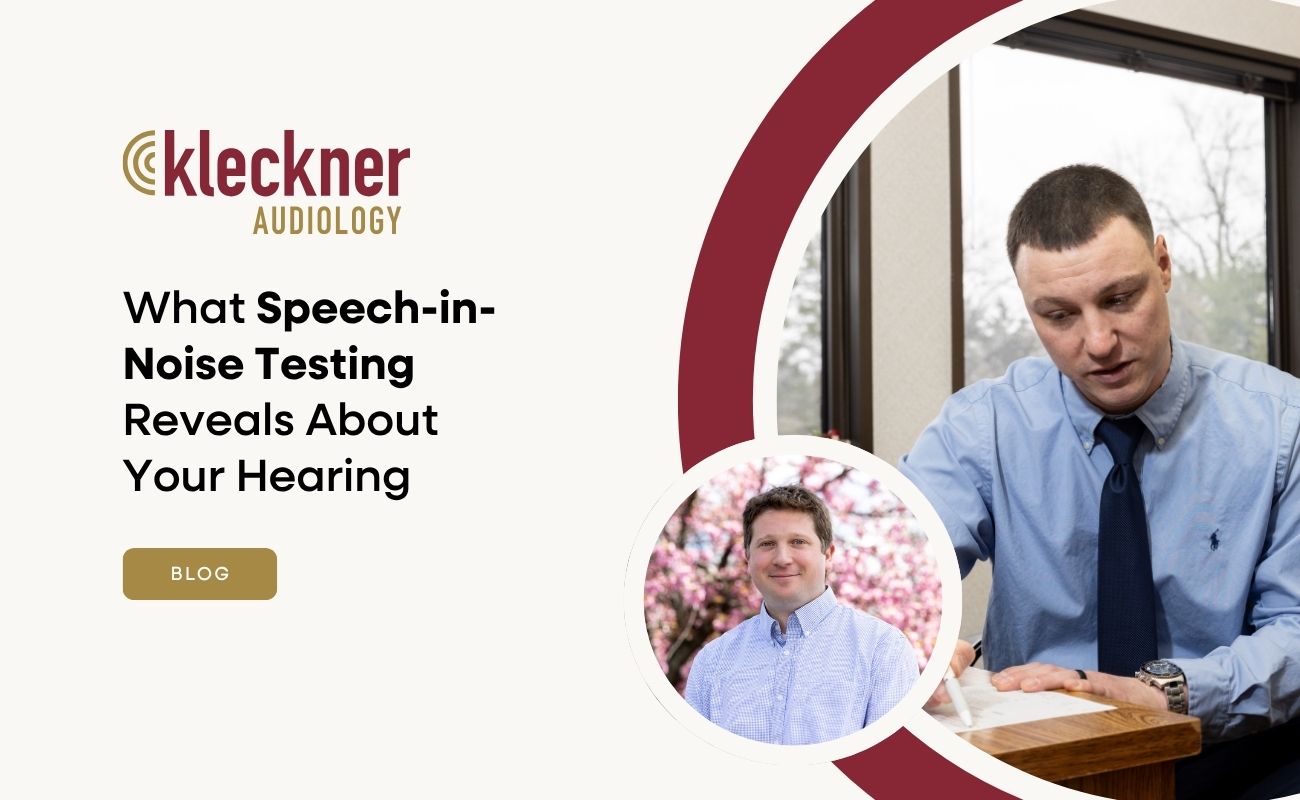
During speech-in-noise testing, you'll listen to words or sentences while background noise plays at the same time. The noise level shifts gradually, and we track at what point your understanding starts to break down.
Some people hit that wall much earlier than you'd expect based on their hearing test results. Others hold up surprisingly well. Either way, the results tell us how your brain and ears are actually working together in the conditions that challenge you most (not just in a silent room).
It's one of the most telling tests we include in our comprehensive hearing evaluations at Kleckner Audiology.
What It Catches That Other Tests Miss
There's a condition called auditory processing disorder (APD) where someone can have perfectly normal hearing on a standard test but still struggle to follow conversations in noisy settings. Without speech-in-noise testing, that often gets dismissed as inattention or distraction. People are told to "pay closer attention" when the real issue is neurological, not behavioral.
Speech-in-noise testing reveals what's actually going on.
It's also especially valuable for identifying the practical effects of sensorineural hearing loss — damage to the tiny hair cells in your inner ear that help distinguish subtle sound differences. You might hear that someone is speaking but still miss whether they said "thin" or "shin." A standard test won't catch that. A speech-in-noise test will.
For patients who already wear hearing aids, it works as a benchmark too, helping us confirm whether your devices are actually performing in noisy real-world environments.
How Results Shape Your Hearing Aid Recommendation
If your results show significant difficulty understanding speech in noise, that directly guides which hearing aids we recommend. Modern hearing aids have gotten genuinely good at separating speech from background noise. Some use deep neural network processing. Others use intelligent directional microphones. Several now include AI that adapts to your listening environment automatically.
The brands we carry — Oticon, Phonak, ReSound, Signia, Starkey, and Widex — each handle speech-in-noise performance a little differently. Knowing your specific results helps us match you with the technology most likely to make a real difference in your daily life, not just one that performs well on paper.
Without that data, fitting hearing aids is guesswork. With it, we can be precise.
When You Think Your Hearing Is "Fine"
This is worth addressing directly, because it's one of the most common things we hear. Hearing loss, especially difficulty in noise, tends to creep up so gradually that you adapt without realizing it.
You stop going to certain restaurants. You sit closer to whoever you're talking to. You've started using captions on TV, but you're not sure when that became the default. These small shifts feel normal, but they're actually signals worth paying attention to.
If you're working harder than you used to just to follow a conversation, that's not simply aging. It's your auditory system telling you something has changed.
Find Out What's Really Going On
At Kleckner Audiology, a thorough hearing evaluation means looking at the full picture and not just whether you can detect a beep in a silent room. Speech-in-noise testing is one of the ways we make sure we understand what you're actually experiencing in your day-to-day life, so we can give you advice and solutions that are genuinely useful.
Our team has been serving patients in the Allentown area since 1974. If you're ready to get a clearer picture of your hearing, call us at 610-435-8299 or schedule an appointment online. The right tests make all the difference.

Dr. Peter Kleckner, Au.D., a seasoned audiologist with experience from prestigious institutions, brings his expertise in comprehensive hearing evaluations and treatments to Kleckner Audiology, where he's been serving patients since 2016.